SodaTide FAQ
Twenty-six answers drawn from the product label and the available material — several of them questions the source itself was unable to answer.
Frequently Asked Questions About SodaTide
Formula, amounts, dosing, storage, safety, bundles, postage and refunds.
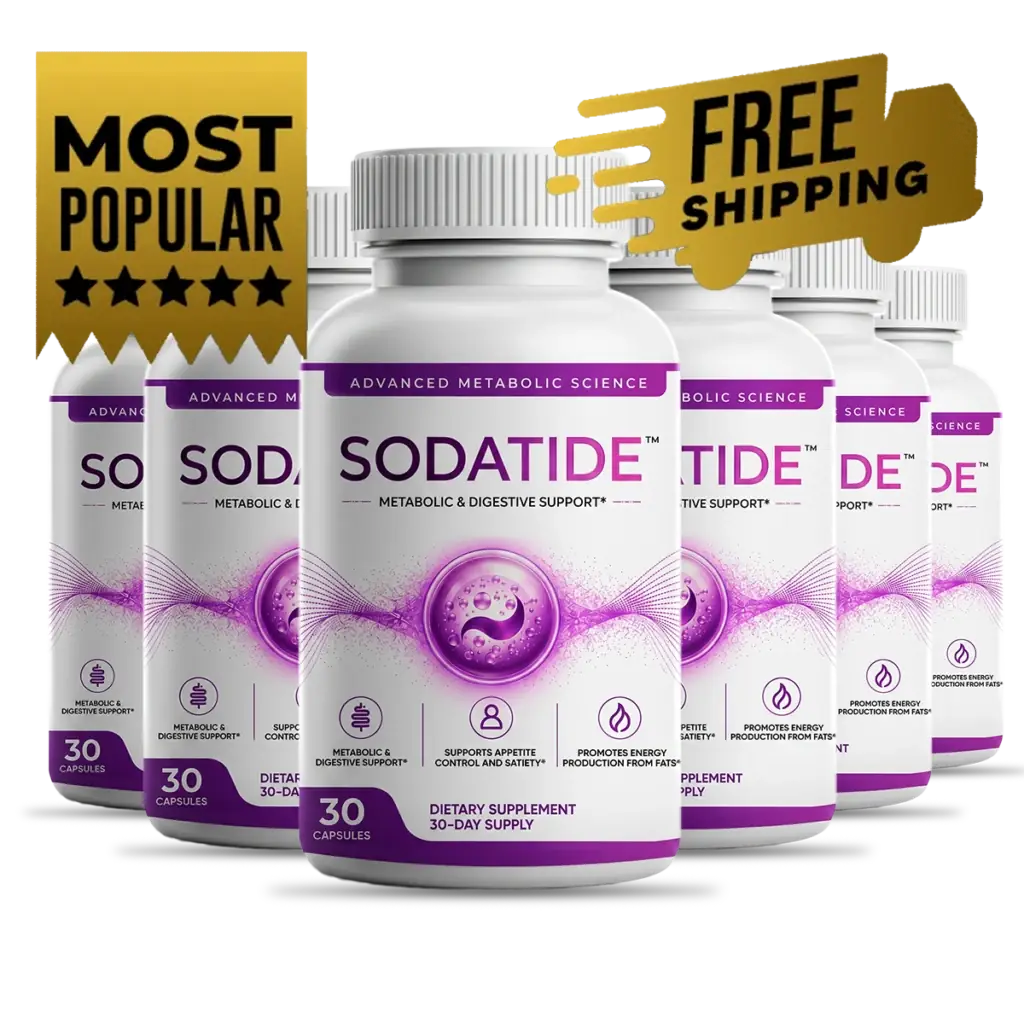
A vegetarian capsule taken once daily that combines prebiotic fibre with live probiotic organisms — a synbiotic. It is positioned around gut balance, digestive comfort, appetite signalling and metabolic energy use. Thirty capsules per bottle.
The material describes support for digestive comfort and regularity, microbial diversity, appetite signals, energy use from food, occasional bloating and the integrity of the gut lining. These are supportive statements for healthy adults, not outcomes and not treatment for any disorder.
Three declared components, with figures read off the label: chicory root inulin 211 mg, potato resistant starch 100 mg, and a 36 mg probiotic blend containing Bifidobacterium infantis, Clostridium butyricum and Akkermansia muciniphila. The remaining ingredients are hypromellose forming the shell, microcrystalline cellulose, magnesium stearate and silica.
Three. The six-item version lists the probiotic blend and then lists its three organisms separately, counting the same 36 mg twice. The panel prints three declared lines with the strains indented underneath.
A soluble prebiotic fibre drawn from chicory root, and about as well characterised as prebiotics get. Human enzymes cannot break it down, so it reaches the colon whole and is fermented there. 211 mg here, against 5–10 grams a day in the research.
Starch that escapes digestion in the small intestine and behaves like fibre once it arrives in the colon. It ferments later and further along than inulin does, which is why combining the two makes sense. 100 mg here, against 15–30 grams a day in studies.
Three organisms named on the label: Bifidobacterium infantis, Clostridium butyricum and Akkermansia muciniphila. The blend weighs 36 mg. No strain codes and no colony count are given.
Because it is unusual and genuinely interesting. It lives in the gut's mucus layer and sits near the centre of current metabolic microbiome research. Two caveats: most of the striking findings come from animal work, and a lot of the human research has used pasteurised, non-viable cells. Which form is in this capsule is not stated.
Nobody publishes that. The blend is declared by weight, and weight cannot be converted into colony forming units. It is a reasonable thing to ask before buying six months of anything.
One capsule a day with an 8 oz glass of water, ideally at a consistent hour. Keep it refrigerated. Regularity matters more than the specific time.
Easily — one capsule with water, nothing to prepare. The single complication is that it belongs in the fridge, which makes it less portable than something you could carry in a bag.
Yes. The label asks for refrigeration for optimal quality and for the bottle to be kept away from heat, light and damp. Six bottles is six months of fridge space, and nothing is chilled in transit.
Yes. The capsule shell is hypromellose, a plant-derived material, and the formula is described as vegetarian and non-GMO.
Possibly, during the first week. Mild, temporary digestive adjustment is the standard response to any new prebiotic or probiotic and usually settles. Inulin is a fructan, so it is relevant if you follow a low-FODMAP diet.
Anyone under 18, and women who are pregnant or nursing. Anyone with a compromised immune system, a serious digestive condition, or a prescription should speak to a doctor before starting.
The gut changes gradually, and the source describes noticeable differences arriving after several weeks of unbroken use. Given 347 mg of total actives, the realistic expectation is something digestive early on — most likely wind — and not a great deal after that.
Two bottles at $79 each ($158 plus $9.99 postage), three at $69 each ($207), or six at $49 each ($294). Every bottle holds 30 capsules.
Each is $79 multiplied by the bottle count — the entry-tier rate spread across the pack rather than a former retail price. The real gaps are $0, $30 and $180. On the smallest bundle the comparison figure equals the price, so it shows no reduction whatsoever.
Roughly $2.63 a day on two bottles (about $2.80 with postage), $2.30 on three and $1.63 on six.
Included on the three- and six-bottle packs. The two-bottle pack adds $9.99.
Sixty days from purchase, arranged through customer support. The version of the offer used here carries no minimum trial period, so none is claimed. Two things go unpublished: who pays return postage, and whether opened bottles are accepted.
Only the two-bottle pack, which runs exactly 60 days against a 60-day window. Three bottles runs 90 days and six runs 180 — triple the window. Note the purchase date the day you order.
It is described as a single charge with no rebill, which counts in its favour. Confirm it at the checkout before paying, as with any order.
Six bonus covers exist in the asset set, but no contents, values or eligibility are documented in the material behind this site, so none are stated. The bonuses page explains.
No — and no supplement is. It is produced in an FDA-registered facility, which is a filing about the plant rather than approval of the product. The source states this correctly itself.
No. Individual results may vary, and a testimonial is not a forecast. There is no trial of the finished capsule, and the cited research examines the ingredients rather than the product.
Four SodaTide Questions Nobody Outside Can Answer
All four are fair to put to the seller before spending anything.
How many colony forming units are in a capsule? Comfortably the most useful question on this list. A weight in milligrams says nothing about how many organisms survive to reach you.
What are the strain codes? Three species is good disclosure. But strains of one species behave differently, and the code is what connects a product to a specific published result.
Is the Akkermansia alive or pasteurised? A real question for this organism in particular, and not something a label is obliged to state.
What exactly are the return conditions? Who covers postage, and whether an opened bottle qualifies. Neither is published.
Not one of these has been estimated anywhere on this site.
The number missing from the SodaTide probiotic blend
The blend is declared the only way a label can declare a mixture: by weight, 36 mg. It is also the one line on the panel that tells you nothing useful.
Live cultures are counted, not weighed. The unit is colony forming units — how many viable organisms actually go down with the capsule. A milligram figure describes the powder, and probiotic powder is mostly the carrier the organisms are suspended in. Two products could both declare 36 mg and differ by a factor of thousands in what is alive inside them, with nothing on either label to tell them apart.
Published probiotic trials generally work somewhere between one and fifty billion CFU a day, and they report that figure because it is the one that governs the result.
So where does that leave a buyer? Three named organisms is better disclosure than most blends offer. How much of them you are getting is unknowable from anything published — which makes it a reasonable thing to ask the seller before committing to half a year's supply.
Where SodaTide stops and medicine starts
This is a food supplement, not a treatment for anything. The source repeats that itself, correctly. It does not treat irritable bowel syndrome, inflammatory bowel disease, obesity, diabetes or any other diagnosed condition.
Some symptoms belong to a doctor and not to a capsule, and it is worth being precise about which. Weight falling off without explanation, abdominal pain that does not let up, blood in your stool, a change in bowel habit that persists, or trouble swallowing all need looking at properly. So does fatigue that will not shift — anaemia, thyroid disease, coeliac disease, diabetes and sleep apnoea are all on that list and all findable with a blood test.
Prebiotic fibre cannot tell ordinary bloating apart from something that needs investigating. A doctor can.
The SodaTide 60-Day Money-Back Guarantee
Two months from the day you buy. If the product falls short of what you hoped for, you ask customer support for your money back inside that window. The order is a single charge with nothing recurring behind it.
No minimum trial period is attached to this offer as it is described here — other pages about this product do attach one, and that condition has not been carried across. Check the live refund policy before you buy, since these terms belong to the seller and can be revised.
Matching a SodaTide bundle to the refund window
The window is fixed at 60 days. What you buy may last far longer than that.
- Two bottles run exactly 60 days. The only pack you can finish while still being able to ask for a refund.
- Three bottles run 90 days — a month past the deadline.
- Six bottles run 180 days. By the time the window shuts you will have taken roughly a third of what you paid for, and be committed to the rest.
Write the purchase date down. Two things nobody publishes: who covers return postage, and whether an opened bottle can go back.
Thinking About Buying SodaTide?
Start on the ingredients page. The per-capsule amounts and the three strain names there were read straight off the bottle — the very check the source material tells its readers to run for themselves. Those numbers are what should decide this, not the packaging.
$49 a bottle at the lowest · 60 days to change your mind · One capsule daily