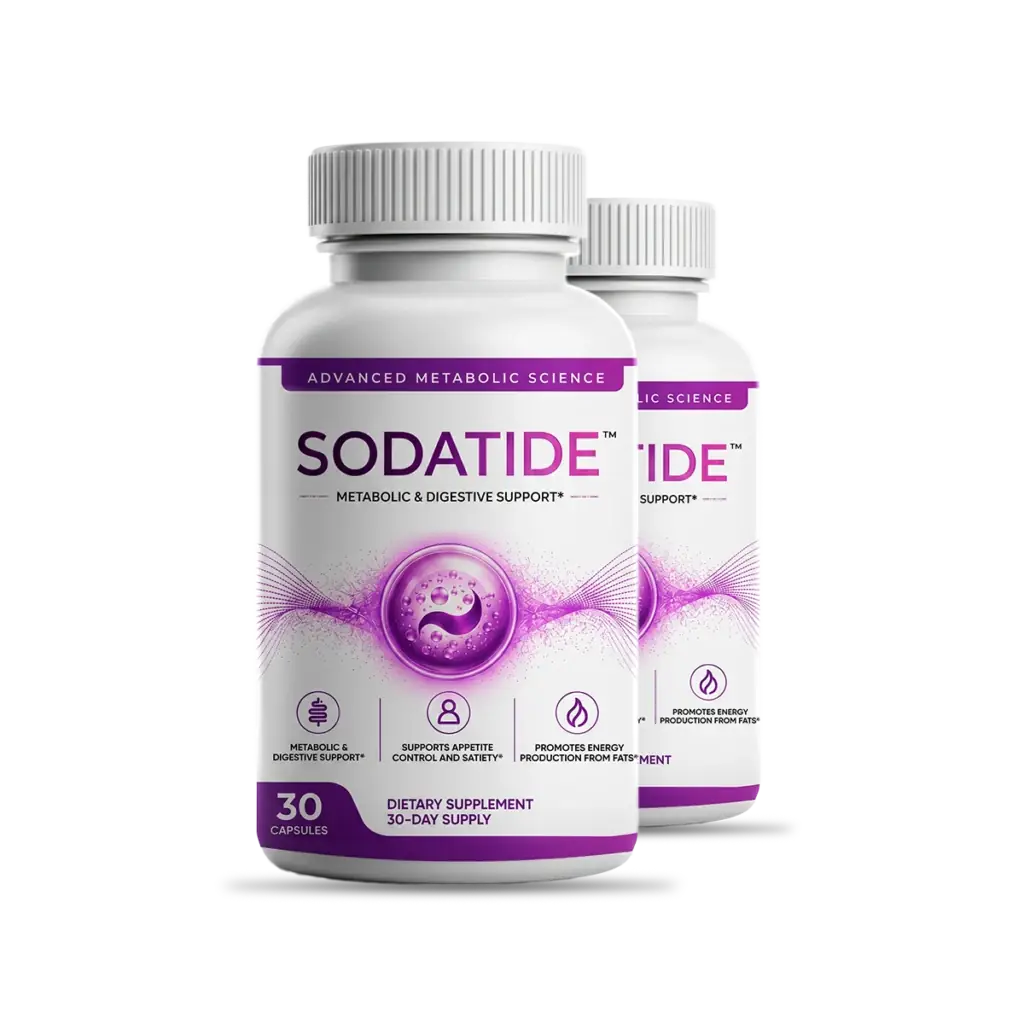
Prebiotic + probiotic in one capsule 347 mg declared per serving Keep refrigerated
The formula

SodaTide Ingredients

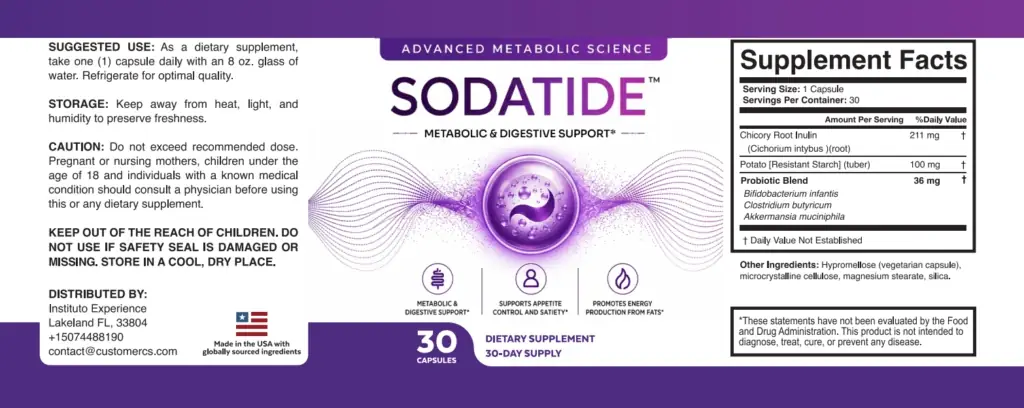
Three declared components with their milligram figures, and the three organisms inside the blend — all read off the bottle, which is precisely the check the source material asks its readers to make.

The SodaTide label showing the complete Supplement Facts panel with per-capsule figures

A Supplement Facts panel is the legally required statement of contents, and here it decides both open questions at once — how much of each thing is present, and how many things there actually are.

The figures

Every SodaTide Amount, Printed

The crux of the product, and worth reading before anything else.

Reading the SodaTide Supplement Facts panel

The material behind this site is unusually frank about a gap in its own reporting. It says the official SodaTide website could not be reached, that its product details came from a third-party review and from the packaging, that it was unable to check the formula against an official label, and it asks readers to confirm things against the bottle in their hands.

The bottle was available here. Its Supplement Facts panel closes the gap, and this is what it prints:

What is declaredPer capsuleWhat studies used
Chicory Root Inulin211 mg 5,000–10,000 mg daily in prebiotic work
Potato Resistant Starch100 mg 15,000–30,000 mg daily in most trials
Probiotic Blend36 mg Counted in CFU, never in milligrams — not published
Everything active, added up 347 mg In one capsule, taken once

Beneath the blend the panel names its three organisms: Bifidobacterium infantis, Clostridium butyricum and Akkermansia muciniphila.

Why the numbers change everything. An ingredient list on its own cannot be argued with, because there is nothing in it to measure. Put amounts beside it and the question answers itself: the inulin here is somewhere between a twenty-fifth and a fiftieth of a researched prebiotic dose, and the resistant starch between a hundred-and-fiftieth and a three-hundredth of one.

None of this is hidden from anybody — it is printed on the bottle for anyone who turns it round. It is a limit of the format rather than an act of concealment: fibre takes up room, and grams of it will not go into one swallowable capsule. A bowl of porridge, a pear, a ladle of beans — each delivers fermentable fibre by the gram. Hold that thought when you weigh up what a single daily capsule can plausibly do.

Counting the SodaTide formula properly: three, not six

You will see this formula described as having six ingredients, itemised as chicory root inulin, potato resistant starch, probiotic blend, Bifidobacterium infantis, Clostridium butyricum and Akkermansia muciniphila.

The last three are what the third one contains. They are the organisms inside the probiotic blend, not additional ingredients sitting next to it, so listing them separately tallies the same 36 mg twice over.

The label removes any doubt. Its panel carries three declared lines — the two fibres and the blend — with the strain names set indented underneath, exactly the convention used whenever a blend is broken out into its parts.

It is a slip in arithmetic rather than a dishonest claim, and an easy one to make. But six sounds like twice the formula that three does, so this site counts three from beginning to end and puts the strains where they belong.

The number missing from the SodaTide probiotic blend

The blend is declared the only way a label can declare a mixture: by weight, 36 mg. It is also the one line on the panel that tells you nothing useful.

Live cultures are counted, not weighed. The unit is colony forming units — how many viable organisms actually go down with the capsule. A milligram figure describes the powder, and probiotic powder is mostly the carrier the organisms are suspended in. Two products could both declare 36 mg and differ by a factor of thousands in what is alive inside them, with nothing on either label to tell them apart.

Published probiotic trials generally work somewhere between one and fifty billion CFU a day, and they report that figure because it is the one that governs the result.

So where does that leave a buyer? Three named organisms is better disclosure than most blends offer. How much of them you are getting is unknowable from anything published — which makes it a reasonable thing to ask the seller before committing to half a year's supply.
All three

The SodaTide Components in Detail

Each with its declared amount and a full page behind it.

Chicory Root Inulin, one of the three declared components of SodaTide
01

Chicory Root Inulin

Cichorium intybus (root) 211 mg declared

The bulk of the capsule by weight, and the fibre with the deepest prebiotic evidence base — though the trials behind that evidence used twenty-five to fifty times more.

Read the detail
Potato Resistant Starch, one of the three declared components of SodaTide
02

Potato Resistant Starch

Solanum tuberosum (tuber) 100 mg declared

Digestion-resistant starch that ferments deeper in the colon than inulin does. It also carries the largest gap on this label between what is present and what was studied.

Read the detail
Probiotic Blend, one of the three declared components of SodaTide
03

Probiotic Blend

Three named live strains 36 mg declared

One declared blend holding three named strains — which is where the “six ingredients” figure comes from. Its live-organism count is published nowhere.

Read the detail

The Three Organisms Inside the SodaTide Blend

These are not three more ingredients. They are what the 36 mg blend consists of, listed beneath it on the panel.

Bifidobacterium infantis
A thoroughly researched Bifidobacterium, familiar from infant gut studies and from irritable bowel trials. What is missing is the strain code, and for probiotics that code is what connects a product to a particular published result.
Clostridium butyricum
A butyrate producer with a long record as a probiotic in Japan. Its genus shares a name with two notorious pathogens, which unsettles people — but those are different species, and C. butyricum probiotic strains have been used safely for decades.
Akkermansia muciniphila
The inclusion the reference highlights, and reasonably so. It colonises the gut's mucus layer, sits near the centre of current metabolic microbiome research, and rarely turns up in supermarket gut formulas.

Two things remain missing: the strain codes and the colony count. A strain code — the letters and digits that follow a species name — is what ties a product to a specific published result, because two strains of one species can behave quite differently. Neither appears anywhere.

Naming three species is still better disclosure than the average blend offers.

Akkermansia muciniphila, the notable name in SodaTide

The source calls this strain “well-studied… not present in every gut-health formula”, and that is a fair way to put it.

Akkermansia makes its home in the mucus lining the gut wall and eats mucin, the protein that lining is built from — which sounds destructive and appears not to be, since grazing on it seems to prompt the layer to renew itself. Population studies keep finding less of this organism in people living with obesity and type 2 diabetes, and a handful of human trials have reported improved metabolic markers when it is supplemented.

Two things to hold alongside that. The eye-catching results are largely from animal work, with a thin human literature underneath. And this is a strict anaerobe that is genuinely hard to keep alive, so a good deal of the human research has run on pasteurised cells that are not viable at all. Whether the Akkermansia in this capsule is living or pasteurised is not stated anywhere, and with no count published either, this part of the formula stays unassessable.

What Else Is in a SodaTide Capsule

The panel's other-ingredients line reads hypromellose (vegetarian capsule), microcrystalline cellulose, magnesium stearate and silica.

All four are unremarkable manufacturing excipients. Hypromellose forms the plant-based shell, which is what makes the product vegetarian; microcrystalline cellulose bulks the powder; magnesium stearate keeps it flowing through the machinery; silica stops it caking. Every one is routine and none is a cause for concern.

They are listed here for a single reason: they are manufactured, which is why the supplied “100% natural ingredients” badge does not appear anywhere on this site. The source itself avoids that phrasing, describing the formula as naturally derived and non-GMO instead.

Safety Notes for the SodaTide Ingredients

Sensible precautions before starting SodaTide

The source and the bottle line up here. This is for healthy adults of 18 and over; it is not for under-18s or for women who are pregnant or nursing; and anyone whose immune system is compromised, who lives with a serious digestive condition, or who takes medication should speak to a doctor first.

  • The first week may be windy. Gas or bloating on starting a prebiotic is the expected response, not a warning sign, and it generally passes.
  • Inulin is a fructan. Fructans sit among the FODMAPs that set off symptoms in a lot of people with irritable bowel syndrome, so if you are following a low-FODMAP diet this is directly your business.
  • Live organisms and a suppressed immune system need medical input. That goes double with a central line, or during serious illness. It is the precaution that matters most with any probiotic.
  • Fibre nudges post-meal glucose. If you manage blood sugar, show your doctor the label — and change nothing about prescribed medicine on your own.
  • Chicory is a daisy relative. Ragweed and related allergies are worth taking seriously here.

SodaTide is a food supplement and not a medicine, and it is not intended to diagnose, treat, cure or prevent any disease.

SodaTide needs fridge space — decide before you buy, not after

The bottle asks to be refrigerated for optimal quality and kept clear of heat, light and damp. The source repeats it and calls it “a small but meaningful detail some people miss”, which is right.

It counts in the product's favour that it is said at all. Telling buyers to refrigerate is what you do when there is something living in the capsule worth protecting; plenty of probiotic brands stay quiet about it because it makes the purchase marginally less convenient.

The knock-on effects deserve a moment's thought:

  • Half a year of bottles takes up real space. Six of them is not a token corner of a domestic fridge.
  • Nothing is refrigerated in transit. A product you are told to keep cold at home spends days crossing a courier network at whatever temperature it happens to be. Ordinary for the category, and an argument against ordering in the middle of summer.
  • Travelling gets fiddly. A capsule that lives in the fridge is easy to forget on a trip, and the whole proposition rests on not forgetting.
  • It favours buying little and often — the exact opposite of what the pricing pushes you toward.

Where SodaTide stops and medicine starts

This is a food supplement, not a treatment for anything. The source repeats that itself, correctly. It does not treat irritable bowel syndrome, inflammatory bowel disease, obesity, diabetes or any other diagnosed condition.

Some symptoms belong to a doctor and not to a capsule, and it is worth being precise about which. Weight falling off without explanation, abdominal pain that does not let up, blood in your stool, a change in bowel habit that persists, or trouble swallowing all need looking at properly. So does fatigue that will not shift — anaemia, thyroid disease, coeliac disease, diabetes and sleep apnoea are all on that list and all findable with a blood test.

Prebiotic fibre cannot tell ordinary bloating apart from something that needs investigating. A doctor can.

Bundles

SodaTide Pricing Options

Three sizes, with the comparison figures unpacked rather than repeated.

Entry bundle
SodaTide 2 bottle bundle, 30 vegetarian capsules per bottle

Two Bottles

60 days · 60 capsules
$79a bottle

$158 in total

Listed against $158 — the same number you pay, so this tier shows no reduction at all.

  • 2 bottles of 30 capsules
  • $9.99 US shipping on top
  • 60 days to ask for your money back
  • Charged once, no rebill
Order SodaTide
$49 a bottle — the floor Largest bundle
SodaTide 6 bottle bundle, 30 vegetarian capsules per bottle

Six Bottles

180 days · 180 capsules
$49a bottle

Listed against $474 → $294 in total

A gap of $180

  • 6 bottles of 30 capsules
  • US shipping included
  • 60 days to ask for your money back
  • Charged once, no rebill
Order SodaTide
Ships free Middle bundle
SodaTide 3 bottle bundle, 30 vegetarian capsules per bottle

Three Bottles

90 days · 90 capsules
$69a bottle

Listed against $237 → $207 in total

A gap of $30

  • 3 bottles of 30 capsules
  • US shipping included
  • 60 days to ask for your money back
  • Charged once, no rebill
Order SodaTide

Where $158, $237 and $474 come from. Divide each by its bottle count and the answer is always $79 — the price you would pay per bottle on the smallest bundle. These are not old retail prices that somebody once charged; they are the entry rate carried across each pack size, and the source describes them openly as third-party reference figures. That is a considerably more restrained way to display a discount than the invented recommended-retail numbers this category usually reaches for. The consequence is that the genuine gaps are small: nothing on two bottles, $30 on three, $180 on six. Shipping is included on the three- and six-bottle packs and costs $9.99 on the two-bottle pack. Checkout sets the live price and can change it, so treat the official order page as the last word.

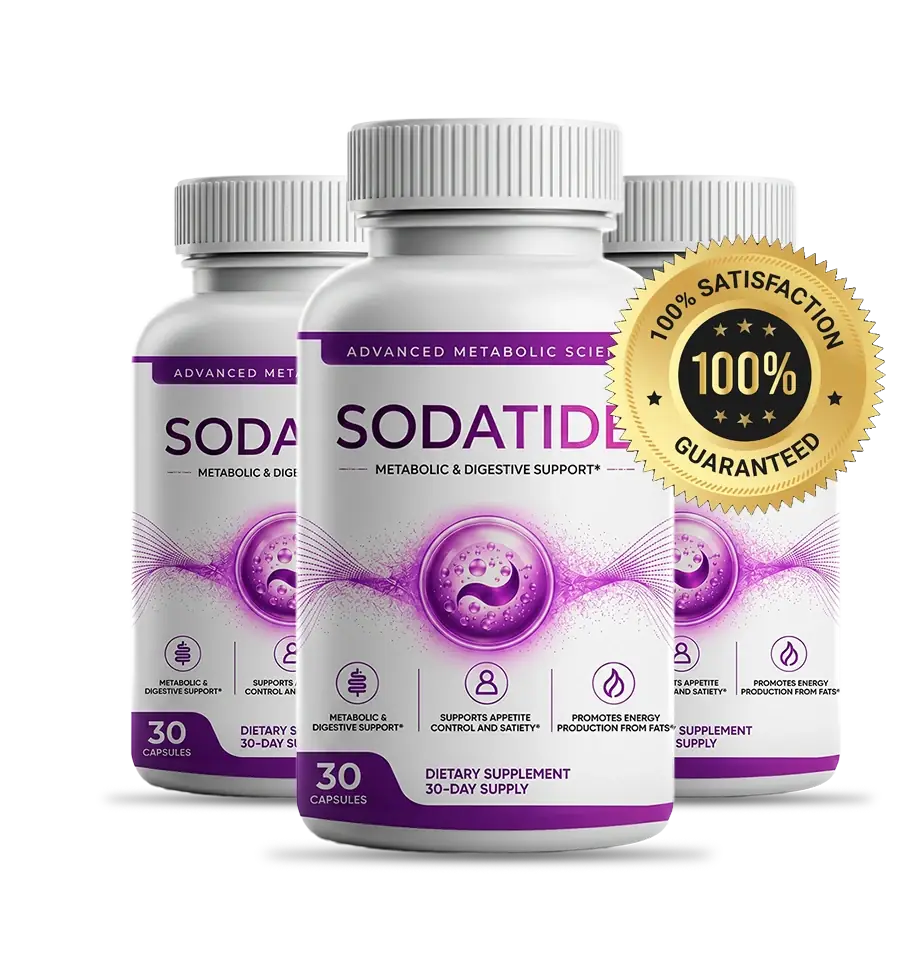
SodaTide bottles pictured with the satisfaction guarantee seal
Refunds

The SodaTide 60-Day Money-Back Guarantee

Two months from the day you buy. If the product falls short of what you hoped for, you ask customer support for your money back inside that window. The order is a single charge with nothing recurring behind it.

No minimum trial period is attached to this offer as it is described here — other pages about this product do attach one, and that condition has not been carried across. Check the live refund policy before you buy, since these terms belong to the seller and can be revised.

Matching a SodaTide bundle to the refund window

The window is fixed at 60 days. What you buy may last far longer than that.

  • Two bottles run exactly 60 days. The only pack you can finish while still being able to ask for a refund.
  • Three bottles run 90 days — a month past the deadline.
  • Six bottles run 180 days. By the time the window shuts you will have taken roughly a third of what you paid for, and be committed to the rest.

Write the purchase date down. Two things nobody publishes: who covers return postage, and whether an opened bottle can go back.

One last thing

Thinking About Buying SodaTide?

Start on the ingredients page. The per-capsule amounts and the three strain names there were read straight off the bottle — the very check the source material tells its readers to run for themselves. Those numbers are what should decide this, not the packaging.

$49 a bottle at the lowest · 60 days to change your mind · One capsule daily

SodaTide six-bottle bundle of synbiotic capsules